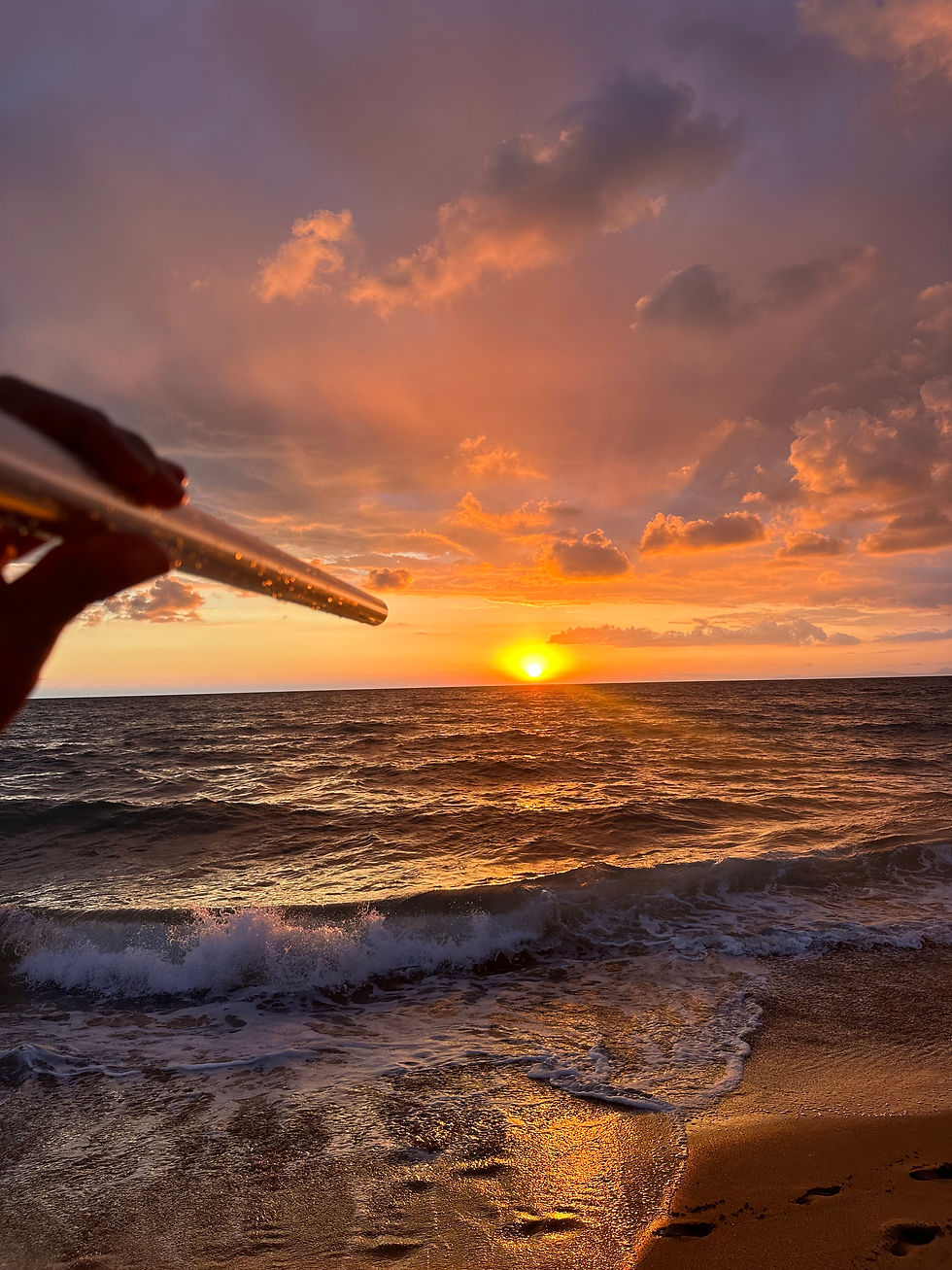
My experience with Vipassana course in Spain
In my previous article, we explored the foundations of Vipassana and the core pillars of this ancient discipline. Today, though, I’d like to take a step back and share how my own path crossed with the practice, the different approaches I’ve navigated, and why—despite finding it to be a deeply valuable experience—it must be met with clear and grounded awareness.
How did I find out Vipassana
Curiosity about meditation has been a part of my life for as long as I can remember. The trouble was, I had no real idea where to begin, as it wasn’t something deeply rooted in Italian culture. So I started digging into books, reading up, and experimenting with various forms of practice, chasing the belief that there must be a single "best" method out there. Looking back, I was probably drawn to the most obscure, non-Western techniques partly just to feel unique.
I still vividly recall an early conversation with a Buddhist monk. I asked him outright what the best meditation method was.
He looked at me and said, "Think of it like knowing there is water underground. To find it, you have to dig. You can test out a few different spots, but at some point, you have to trust your intuition and keep digging in the exact same place. Try different practices, but once you find the one that resonates with you, give it time and patience until you hit water. There is no absolute best method; there is only the right meditation for you."
I stumbled upon Vipassana almost by accident and tried practicing it on my own at home. The result was almost comical, as I ended up feeling even more stressed than when I started. On paper, it sounded so straightforward. Don't force your breath, observe every sensation or thought as it arises, and simply let it go. In theory, it’s the most natural thing in the world, but in practice, I can assure you it was one of the hardest things I’ve ever tried to do.
At first, I tried to figure it out by myself by buying books, joining European meditation communities to exchange thoughts, and watching countless videos. Eventually, I realized there were official retreats available right here in Europe, and I knew that the only way to truly understand what I was doing was to jump in with both feet.
S.N. Goenka and Traditional Vipassana , core and differences
I used to believe there was only one Vipassana method, but I quickly realized that wasn't the case the moment I started my first retreat in Spain. There, they practiced the approach reinterpreted by S.N. Goenka, centered entirely on seated observation, sometimes individually and sometimes in a group setting.
The Goenka method is the most widely practiced form in the world, renowned for its ten-day retreats that are completely free of charge and funded solely by donations from former students. This school stands out for its remarkably precise, structured, and egalitarian framework, built on an identical daily routine for everyone, evening discourses recorded by Goenka himself, and a laser-like focus on the body scan technique.
In its older forms rooted in the Theravada tradition of Southeast Asia, Traditional Vipassana can vary significantly depending on the teacher and the center. In that context, you often find more room for walking meditation, direct dialogue, and ongoing interaction with teachers, with a tempo that adapts more fluidly to individual needs. Recognizing that Goenka’s model is an excellent framework rather than the only one helps you approach the practice with greater mental flexibility.
So what exactly are the precepts you need to follow during a Goenka retreat, and how is the daily routine laid out?
Upon arrival, all students sign a commitment to uphold the five fundamental precepts of Theravada Buddhism for the full ten days.
The first is to abstain from killing or destroying any living creature, which is why the food served is strictly vegetarian or vegan and effort is made to avoid harming even insects. The second is to abstain from taking what is not freely given. The third is complete abstinence from any sexual activity, ensuring absolute celibacy throughout the course. The fourth is to refrain from lying, which in practice translates into maintaining Noble Silence. The fifth is total abstinence from intoxicants, with zero exceptions for alcohol or drugs.
For those who have already completed at least one ten-day course, three additional precepts come into play. The first is an evening fast after noon, meaning returning students stop eating solid food after twelve and receive only tea or herbal infusions at five in the afternoon, whereas new students are permitted to eat fresh fruit. The second is abstaining from any form of personal ornamentation, cosmetics, or entertainment, stripping away superficial distractions. The third is foregoing overly comfortable or elevated beds and seating, choosing essential simplicity instead to foster humility and presence.
Rules for Living Together
Life inside the center is governed by very clear guidelines. Noble Silence prohibits speaking, eye contact, physical gestures, and written notes to other participants, leaving communication open only with the teacher for guidance on the technique or with management for practical needs.
All technology is turned in at registration alongside books, journals, and music to foster an environment free of distraction. Men and women live in completely separate areas, from dormitories to dining spaces and walking paths. Finally, religious items or rituals are not permitted, so rosaries, crystals, and sacred imagery are deposited upon arrival to avoid blending other practices with the method.
Daily Routine
Daily Routine
The day begins well before dawn and includes roughly 10 to 11 hours of total meditation practice.
04.00 Wake-up bell
04.30 – 06.30 Meditation in the main hall or in your room
06.30 – 08.00 Breakfast and break
08.00 – 09.00 Mandatory group meditation in the hall (Adhiṭṭhāna, strong determination, sitting without moving hands or legs)
09.00 – 11.00 Guided meditation in the hall or in your room according to instructions
11.00 – 12.00 Lunch, the main meal of the day
12.00 – 13.00 Rest and optional individual interviews with the teacher
13.00 – 14.30 Meditation in the hall or in your room
14.30 – 15.30 Mandatory group meditation in the hall
15.30 – 17.00 Guided meditation
17.00 – 18.00 Tea break with fruit for new students and herbal tea for returning students
18.00 – 19.00 Mandatory group meditation in the hall
19.00 – 20.15 Evening video discourse by Goenka, explaining the theory behind the day's practice
20.15 – 21.00 Final meditation in the hall
21.00 – 21.30 Question period with the teacher
22.00 Lights out and rest

How did I feel before and after the Course
It is hard to put into words what you go through during a retreat, and perhaps it isn't entirely right to try, as it risks influencing the experience of whoever reads it. Still, I’d like to open a small window into it. There were moments of profound stillness interspersed with times when my mind was desperately looking for an escape route. It isn't rare to see people leave before the course ends. If that happens, there is nothing wrong with it, and it shouldn’t be viewed as a failure. Instead, it’s simply your body and mind clearly signaling that, for now, that is enough. I also believe there is no need to share every single detail. Certain dynamics, breakthroughs, and emotions that surface over hours of silence are meant to stay within a personal, intimate space.
I vividly recall the struggle of the first few days and the constant question knocking at the back of my head, asking what I was doing there and whether this was truly the best way to spend my time off. Yet, I remember with equal clarity how, after about five days, a initial feeling of unexpected lightness began to emerge.
During practice, various past traumas that I thought I had long processed began to resurface. Through some strange wiring of the mind, in that deep silence, I started visualizing my life as a giant emotional lasagna. Every layer represented a knot or heavy weight accumulated over time, and meditation had become my way of peeling that lasagna back, shaving off one layer at a time to finally make it lighter and easier to digest.
That was when I felt a state of lightness so intense it almost felt altered, not unlike what certain substances can induce. In that moment, I realized that those recreational shortcuts are nothing more than a hasty attempt to reach a state of mind that authentic meditation offers with far more calm and grounded presence. It directly dismantles that modern Western mindset that demands everything instantly.
One of the most striking and curious memories I carry with me is the incredible diversity of the people there. There were participants from every corner of the globe, spanning all backgrounds, walks of life, and religious beliefs. I remember being surprised to see two priests sitting there meditating alongside the rest of us. Watching them in that shared silence was visual proof of how inner inquiry completely transcends labels, affiliations, or religious dogmas.
Once the experience comes to an end, what you take home is not some cosmic enlightenment, but a extraordinary sense of clarity. A kind of mental reset that restores your ability to observe reality with far less emotional reactivity, topped off with the invaluable perk of a total digital detox. By the end of the retreat, my awareness was so sharp that I could recall every single dream I had during the night.
To celebrate finishing the course, I decided to treat myself to a pistachio croissant and a cappuccino at my favorite spot in Barcelona. My body rejected it immediately in the most visceral way. It was the unequivocal sign of a system refusing to be thrown back too abruptly into the noise of daily life.
In Conclusion: Finding Official Retreats and Taking Your First Steps
Vipassana is truly accessible to anyone, provided you approach it with the right mindset and maturity. Before taking such a significant step, my advice is to lay a bit of groundwork first. It is well worth spending time reading up, watching informational videos, and perhaps seeking out local groups to get a feel for the practice before diving in.
A critical point to keep in mind is the ethics behind the discipline. Be cautious of anyone asking for money or offering paid courses. This entire tradition rests on the principle of free offering and the sharing of Dhamma, the teaching. The practice must remain open to everyone, sustained purely through voluntary donations and service.
To locate official centers in the Goenka network worldwide, your main reference point is dhamma.org, which lists all available courses and schedules. When registration opens, spots tend to fill up within minutes, but do not be discouraged if a course appears fully booked right away. I strongly recommend joining the waiting list anyway. Last minute cancellations happen all the time, and spots open up far more often than you might think.
If ten consecutive days feel like an intimidating hurdle to start with, remember that shorter introductory retreats or guided meditation weekends also exist. Alternatively, you can choose to join a course as a volunteer server, experiencing the retreat through service to others, which is another profound way to cultivate presence.
Silence is only frightening as long as it remains a stranger. Once we truly learn to inhabit it, we realize it is one of the most precious gifts we can ever give ourselves.