Camino de Santiago: History and Routes
Page 113:
"There's a strange peace in not knowing where you'll sleep tonight, a blind trust that the path will, somehow, take care of you."
Pondering this quote by Raynor Winn, I tried to keep my mind distracted, while the usual questions bounced around me: “Where exactly is Oviedo?” “And you prefer to spend the only three weeks of vacation you have a year to tire yourself out even more?” “You must be crazy!” Thinking about how one can truly get rich between a plague and a boil, I responded almost on autopilot to the doubts of those around me: “Ah, but you do it because you're Catholic?” “No.” “Then why?” “I don't know.” The truth is, I didn't have a ready or definitive answer. Maybe in the eyes of others I seemed confident, but this time I was improvising—after all, I've always been good at it. Only months later, walking the Galician roads, did I begin to seriously ask myself: what drives so many people to put on a backpack and walk for hundreds of kilometers? Are they running away from something? Or are they seekers of nothingness just like me?
In this article, I'll try to provide a little context about the Camino and its symbols. I'll then dedicate other sections to sharing my personal experiences on the routes I've traveled and all the advice I wish I'd read before setting out.
The origins: How the myth was born
To understand what the Camino is today, we must go back in time to the 9th century. Imagine Galicia back then: a wild, foggy land, on the edge of the known world. Legend has it that a hermit named Pelagius, looking up at the sky, noticed something unusual: a shower of stars, or strange flashes, that always seemed to point to the same exact spot in a dense forest. Intrigued, he went to investigate and discovered a forgotten tomb. It was the tomb of the Apostle James the Greater (in Spanish, San Yago, hence the name Santiago). The place took the name Campus Stellae (the field of stars), which over the centuries has slipped in pronunciation until it became the word we all know: Compostela.
News of the discovery spread across the continent at a speed astonishing for the time. That small, isolated Galician village transformed, almost overnight, into a magnet for humanity. Along with Rome and Jerusalem, Santiago became one of the three great pilgrimages of Christianity. And it is here that history becomes incredibly human: for centuries, kings, saints, criminals seeking redemption, and illiterate peasants walked the same mud, sharing bread and blazing trails across Europe. Unknowingly, that wave of people was creating the first true network of cultural exchange in modern history, shaping the profound identity of an entire continent.
The Symbols: The Concha and the Compostela
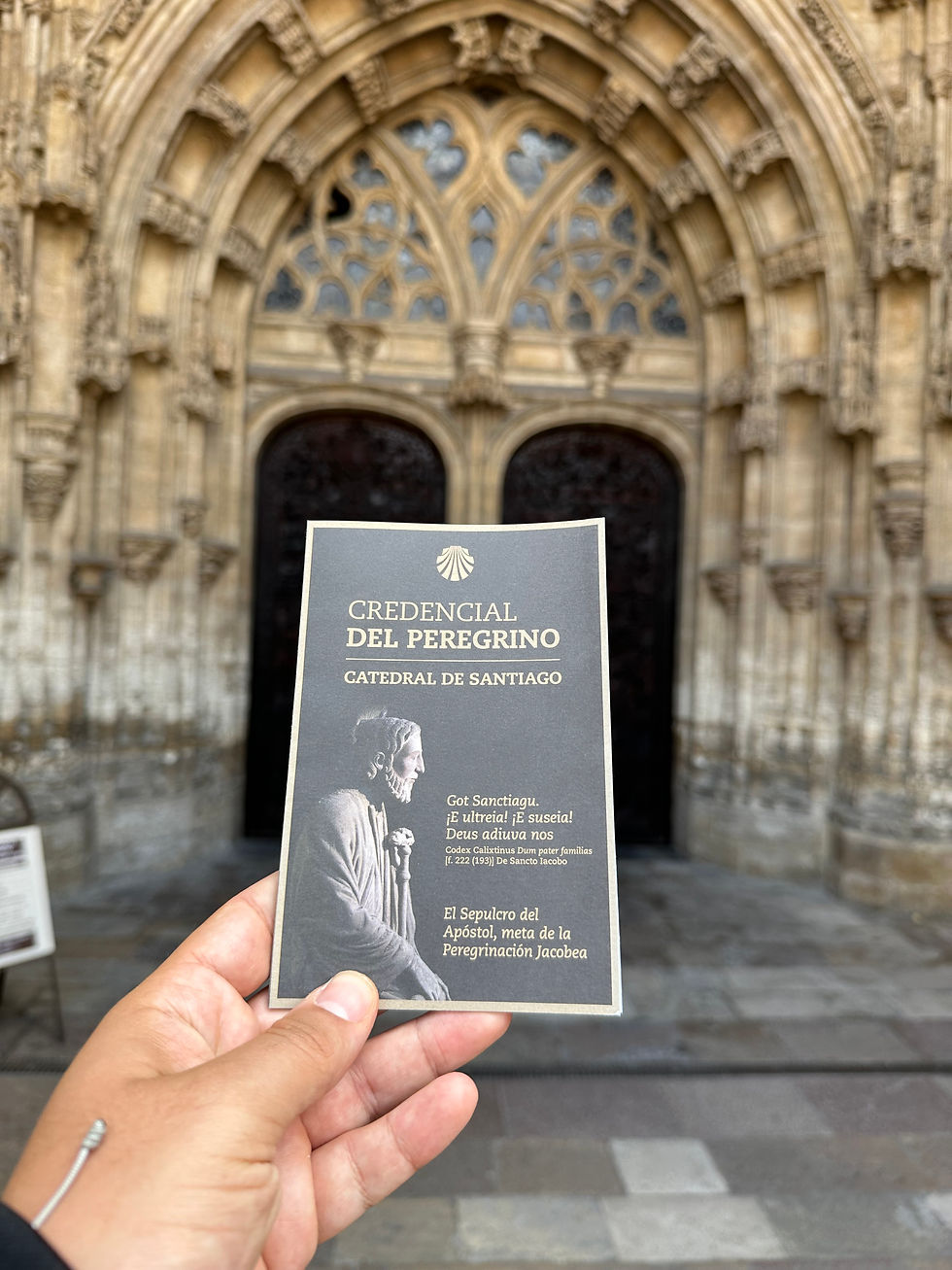
Anyone who sets out on a journey today carries with them, or encounters along the way, a series of objects and rituals. They aren't simple souvenirs; they're a secret code, invisible threads that connect our steps to those of medieval pilgrims. Here are the most important symbols that will become your traveling companions:
La Concha (The Shell): It is the symbol par excellence. In ancient times, pilgrims didn't buy one upon departure: they collected it on the beaches of Finisterre, the farthest point of Galicia facing the ocean, as tangible proof of having reached their destination. It also had an incredibly practical use: it was the perfect spoon or natural cup for drinking from springs. Today, hanging from a backpack, the shell is the symbol par excellence, a metaphorical compass.
The Credential (Pilgrim's Passport): This is your new identity document. It's a cardboard booklet you can get in your departure city (free from the relevant cathedral) that you must have stamped (with the "veneranda") every day at hostels, churches, bars, or even town halls along the way. It not only gives you access to affordable hostels , but also serves as "proof" for obtaining the Compostela (in theory, at least two stamps per day for the last 100 km are required, but in practice, they aren't so strict). It also becomes an emotional map and a repository of memories.
The Compostela: this is the official document in Latin issued by the Pilgrim's Office in Santiago if you demonstrate, stamp after stamp on your Credential, that you have walked at least the last 100 km or cycled 200 km. The document itself is free; if you wish to receive an additional parchment certifying the exact number of kilometers traveled, the cost is 3 euros. You can also choose not to request it: I have walked with many people who chose not to, precisely because they did not want to introduce a "material" or commercial dimension into an experience that, for them, should remain exclusively internal.
El Bordón (The Pole, for friends): The classic wooden staff. In the Middle Ages, it was a veritable weapon for defense against wolves and bandits, as well as a third support for tired legs. Today, although many use modern trekking poles, the old wooden bordon retains an immense charm: it taps rhythmically on the asphalt and earth, becoming the metronome of your thoughts. Personally, I've found it very useful as it scares away snakes inadvertently, and it can also be used against stray dogs that, unfortunately, can be found along the trail (special mention goes to Emilio, the Asturian farmer who dispenses the Bordón).
La Flecha Amarilla (The Yellow Arrow): This, I swear, will become your best friend. Painted on trees, sidewalks, rocks, and walls, the yellow arrow tells you you're not lost. It was created in the 1980s thanks to the intuition of Don Elías Valiña, a parish priest from O Cebreiro, who began drawing them by hand to revive the French Way. To put it in Ron Weasley's words: why couldn't we follow the butterflies? Well, there are no Aragog's spiders on the Camino, but the golden rule is the same. Just follow the yellow and you'll be fine.
The Cross of Santiago: It's the red cross shaped like a sword with a lily at the hilt. A powerful symbol, inherited from the ancient military order of knights who protected pilgrims from the dangers of the road. You'll find it printed everywhere, even on the famous Tarta de Santiago (the traditional almond cake you'll enjoy at the end).
The Botafumeiro: This is the gigantic incense burner of the Cathedral of Santiago, one of the largest in the world. It weighs over 50 kilos and is swung by eight people (the tiraboleiros) at breakneck speed, almost touching the ceiling of the nave. Historical curiosity: in the Middle Ages, it wasn't just used for liturgical purposes, but for a much more "human" reason... it served to mask the pungent odor of pilgrims who, after months of travel without the opportunity to wash, slept crowded together inside the church!
The Stone (The Weight You Let Go): Along many routes (the most famous being the Cruz de Iron on the French Way), there's a tradition of carrying a small stone from home. It represents an inner burden, a pain, a sin, or simply something you want to overcome. When you reach the foot of the cross, you leave it there, atop a mountain of other stones left by thousands of people before you. It's a gesture of devastating psychological power: it lightens your backpack and, metaphorically, your soul.
"Buen Camino": It's not an object, but the sonic symbol of the journey. It's the mantra you exchange with anyone who crosses your path: local farmers, fast cyclists, or other backpacking lunatics like you. Two universal words that break down any language barrier. It simply means: "I see you, I know what you're feeling, good luck on your journey."
Religion and Spirituality: The Blank Canvas of the Journey
This is where preconceptions crumble. As I mentioned at the beginning, when I answered with a firm "no" to those who asked me if I was leaving for Catholic reasons, many were taken aback. The truth is that the Camino doesn't belong to a church; it belongs to those who walk it. In my opinion, there's a huge difference between religion and spirituality (but perhaps I'll discuss this in another article).
What happens when you walk for hours, day after day? The rhythm of your step transforms into a true active meditation. At first, your mind is filled with everyday thoughts, deadlines, and notifications you left at home. Then, slowly, your movement becomes in tune with your heartbeat and breathing. The physical gesture becomes a sense of emptying.
The meaning of the Camino is open: it's a blank canvas just waiting to be painted by those who walk it. For some, it's an athletic challenge to push themselves to their limits; for others, it's a protected space in which to process grief or the end of a relationship. For many, it's a life-saving break from a frenetic career that was draining too much energy, or a profound search for answers. No motivation is less noble than another. This experience certainly presents you with countless internal mirrors. By listening to the stories—sometimes incredible—of other pilgrims, you end up reflecting yourself in different scenarios. Involuntarily, you grow; indeed, you exist: you are expanding your life.
If I had to tell you why, I'd say the Camino forces you to rediscover the essential. When everything you need to survive and thrive is packed into a few kilos of backpack on your back, you realize how many unnecessary extras surround you every day. You lighten up. And in that void, space is created for the disarming beauty of chance encounters.
Wondering which path is best for you or how much time you really need for this experience? Continue reading in the second part of the article: Guide to the routes and the philosophy of the return.


